 ×
×

Your hands are your most valuable precision tools on the job. Whether you are assembling automotive transmissions, cutting structural steel, handling industrial maintenance fluids, or packing freight in a fast-paced warehouse, every task relies on the strength, sensitivity, and dexterity of your fingers.
Yet across busy workshops and industrial plants, hand protection is frequently treated as an afterthought—leading to avoidable lacerations, chemical dermatitis, crushing injuries, and costly operational downtime. Putting on the wrong pair of gloves can often be just as hazardous as wearing no protection at all.
Effective hand protection is not about checking off a compliance box; it is about keeping your frontline crew confident, productive, and returning home safely after every shift.
To help facility managers, safety coordinators, and team supervisors build a safer, more efficient workplace, Iboate has assembled this practical guide on how to choose, wear, and maintain industrial work gloves.
1. How to Choose: Match the Glove to Your Real Job Scenario
Every workstation presents a unique hazard profile. Before issuing protective equipment to your team, assess the dominant physical, thermal, and chemical elements in their daily workflow:
Scenario A: High-Dexterity Metal Fabrication & Stamping
The Hazard: Razor-sharp sheet metal edges, stamping burrs, micro-cuts, and oily components.
The Ideal Solution: 13-gauge or 18-gauge seamless knitted cut-resistant gloves constructed from High-Performance Polyethylene (HPPE) or reinforced composite yarns. Look for micro-foam nitrile palm coatings—the porous microstructure acts like miniature suction cups, channeling oil away from smooth surfaces to ensure a secure, slip-free grip.
Pro Tip: Select gloves rated ISO Cut Level D or E (ANSI A4 to A6). Breathable back-of-hand knitting ensures workers stay comfortable throughout an eight-hour shift without excessive hand sweat.
Scenario B: Heavy Welding, Foundry Work, and Metal Casting
The Hazard: Radiant heat, molten spatter, flying sparks, and heavy abrasive friction.
The Ideal Solution: Heavy-duty cow split leather or premium grain goatskin welder gloves sewn with heat-resistant Kevlar® threading. Cow split leather provides outstanding abrasion defense and thermal shielding for stick and MIG welding, while supple grain goatskin offers the sensitive finger articulation required for high-precision TIG welding.
Pro Tip: Insist on an extended 15 cm safety cuff to shield wrists and lower forearms from rogue sparks and hot slag.
Scenario C: Precision Assembly, Chemical Contact, and Maintenance
The Hazard: Chemical splash, solvent permeation, grease contamination, and delicate tactile needs.
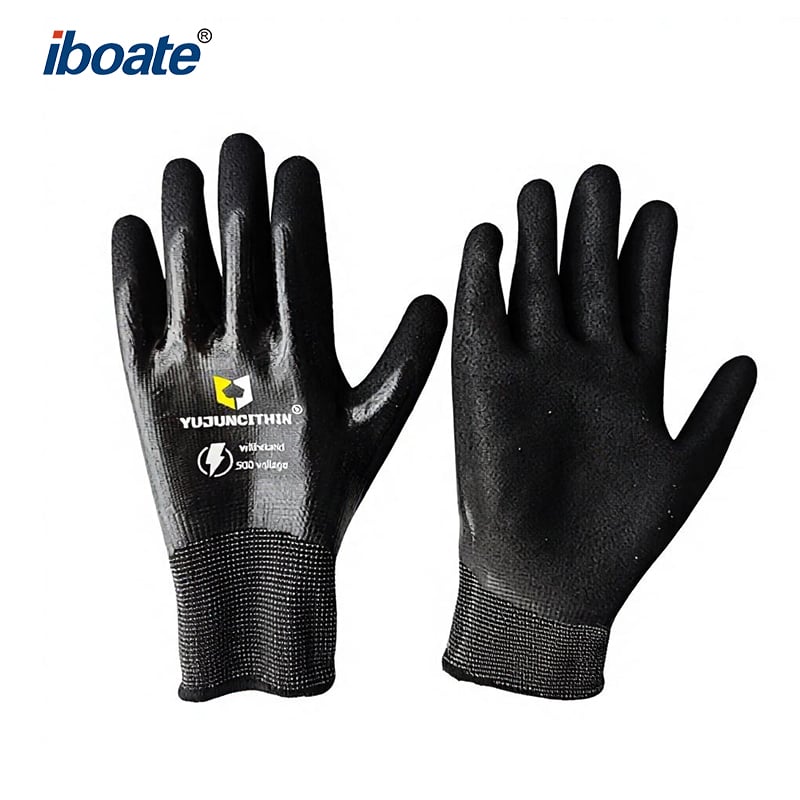
The Ideal Solution: Industrial-grade powder-free nitrile disposable gloves or heavy-duty chemical-resistant nitrile gauntlets. Nitrile delivers superior snag, puncture, and abrasion resistance compared to conventional vinyl or latex, completely eliminating natural rubber latex protein allergy risks.
2. How to Use: Shop-Floor Best Practices for Maximum Safety
Even the highest-grade glove cannot safeguard a worker if it is worn incorrectly or deployed in the wrong setting. Reinforce these three golden rules on your shop floor:
Perform the 5-Second Pre-Shift Inspection:
Before touching machinery or tools, make it a non-negotiable habit to inspect both gloves. Check the thumb-index crotch for unraveling seams, examine palm coatings for micro-cracks or hardening, and look for worn-thin fabric at the fingertips. If a glove shows structural compromise, replace it immediately.
Find the "Second Skin" Fit:
A work glove must balance tension and mobility. A glove that is too tight restricts capillary blood flow, triggers hand cramps, and fatigues muscles rapidly. Conversely, a glove that is too loose leaves excess material bunching at the fingertips, severely reducing tactile control and creating dangerous pinch-point hazards. Always provide accurate sizing charts based on palm circumference and hand length.
The Entanglement Rule:
Never wear gloves when operating unguarded rotating machinery, such as drill presses, lathes, or bench grinders. A glove can catch on rotating spindles and pull the operator's entire hand into the danger zone within milliseconds. Always follow your site-specific Job Safety Analysis (JSA).
3. How to Maintain: Extending Service Life and Lowering PPE Costs
A structured glove care routine does not just protect your workforce—it can also reduce your monthly PPE replacement expenditure by up to 30%.
Washing Without Weakening:
Most modern fabric-backed nitrile and polyurethane (PU) coated gloves are machine washable. Launder them in lukewarm water (under 40°C / 104°F) using mild liquid laundry detergent. Never use chlorine bleach, and never tumble dry at high temperatures. Excessive heat breaks down the elastomeric palm coating, causing stiffness, delamination, and loss of grip. Air drying in a shaded, well-ventilated area is best.
Sensible Storage:
Do not leave work gloves crumpled in damp toolboxes or baking on vehicle dashboards. Ultraviolet (UV) radiation breaks polymer molecular bonds, making nitrile and rubber coatings chalky and brittle within weeks. Store gloves flat or hung in a dry, ventilated locker away from direct sunlight and ozone sources.
Know When to Retire:
Never stretch a glove's service life past its safety threshold. Decommission and replace gloves immediately if:
The protective palm coating has worn away, exposing the knitted inner liner.
The glove has sustained cut marks or punctures longer than 3 mm.
Chemical exposure has caused the material to swell, soften, turn sticky, or harden.
Build a Safer Workplace with Iboate
At Shandong Iboate Security Technology Co., Ltd., we combine cutting-edge fiber engineering, ergonomic design, and strict international quality assurance to manufacture industrial hand protection that workers genuinely appreciate wearing. From rugged leather welding gear to ultra-flexible precision nitrile gloves, our solutions protect frontline teams across manufacturing, construction, energy, and logistics worldwide.
Looking to evaluate certified hand protection for your enterprise or distribution network?
Contact an Iboate safety specialist today to request technical specification sheets, product compliance dossiers, or complimentary sample trial packs for your facility.
Explore Full Product Range: www.iboate.com
Direct Technical & Procurement Inquiries: [email protected]
Manufacturer: Shandong Iboate Security Technology Co., Ltd.
 Hot News
2026-09-28
2026-09-22
2026-09-08
2026-09-04
2026-08-25
2026-08-20
Trusted factory-direct supplier of certified industrial safety gear. CE/ANSI approved, exported to 60+ countries. Stable supply, flexible OEM/ODM.
701-702 Zhenghai Building, No.66 Zhujiang Road, Yantai Development Zone, Shandong Province
Copyright © 2026 by Shandong Iboate Security Technology Co., Ltd Privacy Policy 蜀ICP备17038468号

 EN
EN