
 EN
EN



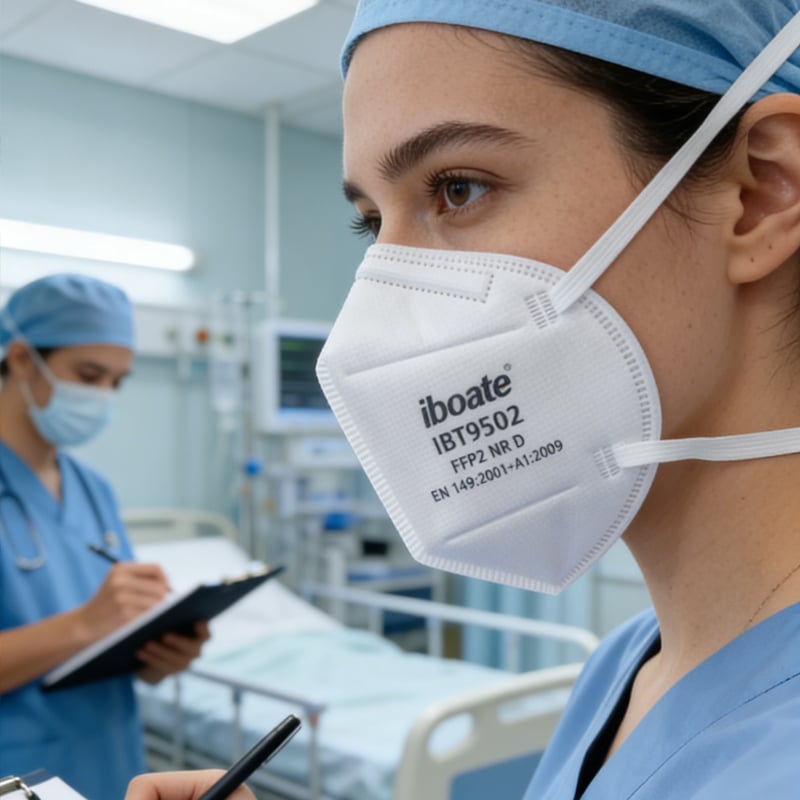
What ≥95% Filtration Efficiency Really Means for N95 Respirators
For an N95 respirator, the claim of ≥95% filtration efficiency means that the respirator must demonstrate at least 95% filtration efficiency under NIOSH certification testing conditions. The testing uses a standardized challenge aerosol under controlled laboratory conditions designed to evaluate filter performance in a most-penetrating particle size range, commonly around 0.3 micrometers (µm). This does not mean that an N95 removes exactly 95% of every particle in every real-world situation, nor does it mean that 0.3 µm is a universal cutoff for filtration.
Understanding what the 95% rating actually represents requires looking at particle-capture physics, NIOSH certification requirements, respirator selection, and the factors that affect protection when the respirator is worn by a worker.
The Physics of Particle Capture: Why the MPPS Matters
Respirator filtration does not work like a simple sieve. Particles can be captured through several mechanisms, including diffusion, interception, inertial impaction, and electrostatic attraction.
Diffusion becomes increasingly important for very small particles because their random Brownian motion increases the likelihood of contacting filter fibers. Interception occurs when particles following the airflow come close enough to a fiber to be captured. Inertial impaction becomes more significant for larger particles that cannot easily follow changes in airflow around filter fibers. Electrostatic attraction can further improve the capture of particles by attracting charged particles to fibers within the filter media.
Because these mechanisms contribute differently across particle sizes, filtration efficiency generally reaches a minimum within a most-penetrating particle size range. For many respirator filter media, this range is commonly associated with particles around 0.3 µm, although the exact MPPS depends on factors such as filter design, fiber characteristics, and airflow conditions.
This is why the 95% rating should not be interpreted as meaning that N95 respirators only work well against particles larger than 0.3 µm. Particles smaller and larger than the MPPS can also be captured efficiently through different combinations of filtration mechanisms.
What the “N” in N95 Really Means
The “N” in N95 stands for not resistant to oil. It does not mean that the respirator is ineffective against viruses, smoke particles, or other non-oil aerosols.
NIOSH classifies particulate-filtering respirators according to both their oil-resistance category and their minimum filtration-efficiency level. The N series is intended for environments where oil aerosols are not present. R-series filters provide limited resistance to oil aerosols, while P-series filters provide stronger resistance to oil.
This distinction is important when selecting respiratory protection for industrial environments. If oil-containing aerosols are present, an N-series respirator may not be appropriate, and the selection should be based on the workplace hazard assessment and the respirator manufacturer's instructions.
The “95” in N95 refers to the minimum filtration-efficiency level established under the applicable NIOSH certification testing conditions. Other classes include N99 and N100, with higher minimum filtration-efficiency requirements.
How N95 Respirators Relate to Viruses, Smoke, and Pollen
N95 respirators can filter many airborne particles that may carry infectious viruses. Respiratory viruses are commonly transported in respiratory droplets and aerosol particles rather than existing only as isolated individual virus particles. The relevant consideration for an N95 respirator is therefore the performance of the respirator against the particles passing through the filter.
The fact that a particle is smaller than 0.3 µm does not automatically mean that it passes through an N95 filter. Particle capture involves several mechanisms, including diffusion and electrostatic attraction, and filtration efficiency varies across particle sizes.
N95 respirators can also filter many particulate components of smoke, dust, and pollen. However, an N95 respirator is a particulate filter and does not provide protection against gases or vapors. For smoke or industrial atmospheres containing gases, vapors, or other chemical hazards, a different type of respiratory protection may be required.
Therefore, N95 selection should always be based on the specific contaminant and exposure conditions rather than simply on particle size.
How NIOSH Certifies N95 Respirators Under 42 CFR Part 84
NIOSH certification requirements for particulate-filtering respirators are established under 42 CFR Part 84. The certification process evaluates respirator performance using defined laboratory conditions, including specified challenge aerosols, airflow, conditioning, and loading requirements.
The purpose of this standardized testing is to provide a reproducible basis for determining whether a respirator meets its designated filter class.
An N95 respirator is therefore not simply a face covering that happens to achieve a 95% filtration result in an individual laboratory test. A NIOSH-approved respirator must meet the applicable certification requirements and be manufactured according to the approved configuration.
For employers and B2B buyers, this distinction is important because a manufacturer's claim of “95% filtration” alone does not make a product a NIOSH-approved N95 respirator.
N95 vs. R95 vs. P95
NIOSH particulate filter classifications combine an oil-resistance category with a filtration-efficiency level.
| Series | Oil Resistance | Efficiency Levels | General Selection Principle |
|---|---|---|---|
| N | Not resistant to oil | 95, 99, 100 | Used where oil aerosols are not present |
| R | Resistant to oil for limited-duration use | 95, 99, 100 | Used where oil aerosols are present for limited-duration exposure |
| P | Strongly resistant to oil | 95, 99, 100 | Used where oil aerosols are present and longer-duration use is required, subject to manufacturer instructions |
The three efficiency levels are commonly represented as 95, 99, and 100, with the “100” classification corresponding to a minimum filtration efficiency of 99.97% under the applicable NIOSH testing conditions.
Higher filtration efficiency does not automatically mean that a respirator is appropriate for every workplace. Respirator selection must also consider the contaminant, exposure concentration, respirator type, fit, breathing resistance, and the applicable Assigned Protection Factor (APF).
How to Identify a Genuine NIOSH-Approved N95 Respirator
A genuine NIOSH-approved filtering facepiece respirator should carry the required NIOSH approval markings. These markings typically include the NIOSH name or marking, filter classification, approval holder or manufacturer identification, model or part number, and the applicable Testing and Certification (TC) approval number.
A TC number typically follows a format such as TC-84A-XXXX for filtering facepiece respirators.
The TC number can be checked against the NIOSH Certified Equipment List to determine whether the respirator corresponds to an approved product.
Buyers should also check whether the markings on the respirator, packaging, and documentation are consistent. Missing approval information, incorrect NIOSH markings, suspicious model numbers, or inconsistencies between the product and its certification information can indicate that a product should be investigated further before use.
For workplaces subject to OSHA respiratory protection requirements, employers should select NIOSH-certified respirators that are appropriate for the identified respiratory hazards and implement the required respiratory protection program.
Understanding NIOSH Filtration Testing
For N-series filters, NIOSH uses a standardized sodium chloride (NaCl) aerosol as part of the certification testing process. The testing is conducted under controlled conditions designed to challenge the filter and measure its particulate filtration performance.
The use of a standardized aerosol provides a reproducible basis for comparing filter performance. It should not be interpreted as meaning that NaCl is a direct substitute for every type of workplace aerosol or biological particle.
Real-world airborne contaminants can differ considerably in size, shape, composition, concentration, humidity, and physical properties. Consequently, the N95 classification establishes a standardized minimum filtration-performance level rather than guaranteeing identical performance against every possible contaminant under every environmental condition.
This distinction is particularly important when an N95 respirator is considered for chemical, biological, smoke, or industrial applications. The filter class addresses particulate filtration, while the overall respirator selection must account for the actual workplace hazard.
Why Laboratory Filtration Efficiency Is Not the Same as Workplace Protection
A laboratory filtration result describes how the respirator performs under specified test conditions. The protection received by a worker depends on additional factors, particularly how well the respirator fits the individual's face.
A tight-fitting respirator can allow contaminated air to bypass the filter through gaps around the face seal. Facial hair, incorrect sizing, improper positioning, damaged components, eyewear interference, or poor donning technique can all affect the seal.
For this reason, a respirator with a filtration efficiency of ≥95% should not be interpreted as providing exactly 95% protection to the wearer.
Workplace protection depends on the respirator's design, fit, use, exposure concentration, and the requirements of the applicable respiratory protection program.
Fit Testing and User Seal Checks
Fit testing is an essential part of a workplace respiratory protection program when tight-fitting respirators are required.
OSHA requires fit testing before an employee uses a tight-fitting respirator in the workplace, when a different respirator facepiece is selected, and at least annually thereafter. OSHA also requires appropriate medical evaluation before an employee is fit tested or required to use a respirator.
Fit testing and a user seal check are not the same thing.
A fit test evaluates whether a particular respirator model and size provides an adequate fit for an individual worker using an accepted qualitative or quantitative fit-testing method.
A user seal check, on the other hand, is performed by the wearer each time the respirator is donned to verify that the facepiece is positioned correctly and that the seal appears to be functioning properly.
Both are important because a high-performing filter cannot compensate for significant leakage around the face.
Facial Hair and Other Fit Considerations
Facial hair can interfere with the seal of a tight-fitting respirator. OSHA's respiratory protection requirements therefore address conditions that prevent a respirator from maintaining a proper seal.
Eyewear, helmets, hearing protection, hoods, and other PPE can also affect the fit or positioning of a respirator in certain applications.
Employers should evaluate PPE compatibility as part of their respiratory protection program rather than assuming that every combination of equipment will work correctly.
Workers should also inspect the respirator before use and follow the manufacturer's instructions for donning, adjustment, cleaning, storage, and replacement.
Choosing the Right N95 Respirator for the Application
N95 respirators are widely used in situations where protection from non-oil particulate hazards is required, but choosing an N95 should not be based on the filtration percentage alone.
A proper selection process should consider:
-
The identity and physical form of the contaminant
-
Whether oil aerosols are present
-
Exposure concentration and duration
-
Applicable occupational exposure limits
-
Required Assigned Protection Factor
-
Respirator type and fit
-
Compatibility with other PPE
-
Workload and breathing demands
-
Manufacturer instructions
-
Workplace respiratory protection program requirements
For example, an N95 may be appropriate for certain dust, mist, and non-oil particulate exposures, while a workplace containing gases or vapors may require a respirator with the appropriate chemical cartridge or canister.
Similarly, the presence of oil aerosols may require an R- or P-series filter rather than an N-series filter.
What ≥95% Filtration Efficiency Does and Does Not Tell You
The 95% number is useful because it establishes a standardized minimum filtration-performance level. However, it does not describe every aspect of respiratory protection.
The rating does tell you that the respirator has demonstrated the required filtration efficiency under the applicable NIOSH certification conditions.
It does not tell you that:
-
Exactly 95% of every particle will be removed in every environment.
-
The respirator blocks all particles larger or smaller than 0.3 µm.
-
The wearer receives exactly 95% protection.
-
The respirator protects against gases or vapors.
-
Any product claiming “95% filtration” is automatically a NIOSH-approved N95.
Understanding these distinctions helps buyers, employers, and workers avoid one of the most common misconceptions surrounding N95 respirators.
FAQ
What does ≥95% filtration efficiency mean?
It means that an N95 respirator must demonstrate at least 95% filtration efficiency under the applicable NIOSH certification testing conditions. The test challenges the filter with a standardized aerosol under controlled conditions designed to evaluate performance in a most-penetrating particle size range.
Does an N95 filter exactly 95% of 0.3 µm particles?
Not exactly. The 95% rating is a minimum filtration-efficiency requirement under specified NIOSH testing conditions. The most-penetrating particle size range is commonly around 0.3 µm, but 0.3 µm should not be treated as a universal cutoff or the only particle size that matters.
Are N95 respirators effective against viruses?
N95 respirators can filter airborne particles that may carry infectious viruses. Their performance is based on filtering particles rather than selectively filtering individual virus types. Proper fit and correct use are also essential for achieving the intended level of protection.
Can N95 respirators filter smoke and pollen?
N95 respirators can filter many particulate components of smoke and can filter pollen and other non-oil particles. However, N95 respirators do not protect against gases or vapors. The appropriate respirator depends on the specific contaminants and exposure conditions.
What does the “N” in N95 mean?
The “N” means not resistant to oil. N-series filters are intended for environments where oil aerosols are not present.
What is the difference between N95, R95, and P95?
The three classifications differ primarily in their resistance to oil aerosols. N-series filters are not resistant to oil, R-series filters provide limited resistance to oil, and P-series filters provide strong resistance to oil. Selection should be based on workplace exposure conditions and manufacturer instructions.
How can I verify whether an N95 respirator is legitimate?
Check the respirator for the required NIOSH approval markings, including the applicable TC approval number, manufacturer or approval-holder identification, model or part number, and filter classification. The TC number can then be checked against the NIOSH Certified Equipment List.
Does fit affect N95 respirator protection?
Yes. A high-efficiency filter cannot provide its intended protection if contaminated air leaks around the face seal. Proper fit testing, correct donning, and a user seal check each time the respirator is worn are important parts of an effective respiratory protection program.
Is fit testing the same as a user seal check?
No. Fit testing evaluates whether a specific respirator model and size fits an individual worker. A user seal check is performed by the wearer each time the respirator is put on to verify that the facepiece is positioned correctly and the seal is functioning properly.
Conclusion
The ≥95% filtration efficiency rating is one of the defining characteristics of an N95 respirator, but it should not be interpreted as a simple promise that the wearer will receive exactly 95% protection in every situation.
The rating comes from standardized NIOSH certification testing designed to evaluate particulate filtration under controlled conditions. The test accounts for a challenging particle-size range, while the actual filtration process involves diffusion, interception, inertial impaction, and electrostatic attraction.
For workplace use, filtration efficiency is only one part of the overall protection equation. Proper respirator selection, fit testing, user seal checks, correct use, exposure assessment, and compatibility with other PPE are equally important.
For B2B buyers and employers, the safest approach is to evaluate the complete NIOSH-approved respirator, verify its certification information, understand the specific workplace hazard, and follow the applicable respiratory protection requirements rather than relying on the “95%” number alone.
Table of Contents
- What ≥95% Filtration Efficiency Really Means for N95 Respirators
- The Physics of Particle Capture: Why the MPPS Matters
- What the “N” in N95 Really Means
- How N95 Respirators Relate to Viruses, Smoke, and Pollen
- How NIOSH Certifies N95 Respirators Under 42 CFR Part 84
- N95 vs. R95 vs. P95
- How to Identify a Genuine NIOSH-Approved N95 Respirator
- Understanding NIOSH Filtration Testing
- Why Laboratory Filtration Efficiency Is Not the Same as Workplace Protection
- Fit Testing and User Seal Checks
- Facial Hair and Other Fit Considerations
- Choosing the Right N95 Respirator for the Application
- What ≥95% Filtration Efficiency Does and Does Not Tell You
-
FAQ
- What does ≥95% filtration efficiency mean?
- Does an N95 filter exactly 95% of 0.3 µm particles?
- Are N95 respirators effective against viruses?
- Can N95 respirators filter smoke and pollen?
- What does the “N” in N95 mean?
- What is the difference between N95, R95, and P95?
- How can I verify whether an N95 respirator is legitimate?
- Does fit affect N95 respirator protection?
- Is fit testing the same as a user seal check?
- Conclusion