 ×

Two shipments of safety gloves can carry the same catalogue number, size, EN 388 marking and unit price, and still perform measurably differently in the field. "Same specification" describes a design target, not a guaranteed outcome for every pair: performance moves with raw materials, dipping process, inspection sampling, storage conditions and the accuracy of the certification behind the product. Batch-to-batch variation is a procurement issue, not a theoretical one.
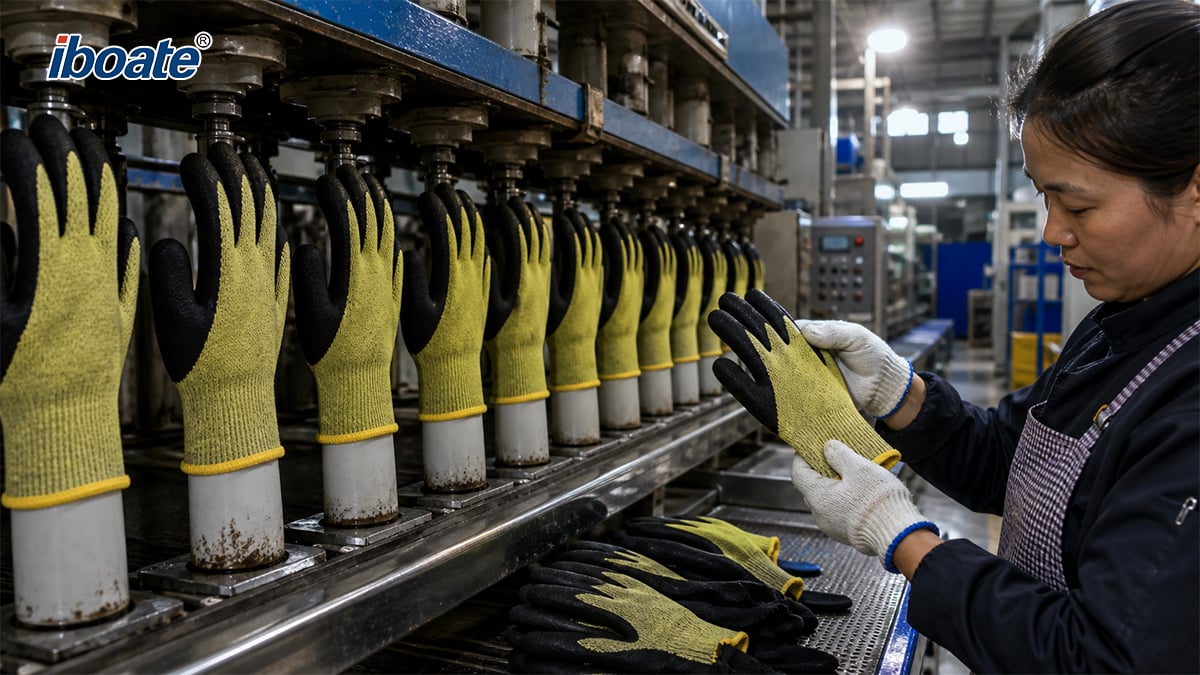
A specification defines what a glove is designed to achieve; batch consistency describes whether each production run delivers it. Four variables a catalogue page cannot show separate them: material inputs, process control, inspection sampling and post-production handling. Because hand protection is a risk-control product, that gap is a safety exposure that procurement and quality control teams can largely manage through testing and contracts.
Natural rubber latex is an agricultural material: dry rubber content, protein and non-rubber constituents, preservation chemistry and tapping season shift between deliveries, changing how the film forms and ages. Nitrile (NBR) compounds vary with acrylonitrile content and with the grade of plasticisers, curatives and fillers between supplier lots. Fibre blends in cut-resistant liners — HPPE, glass, aramid or polyester — vary in linear density, blend ratio and twist, and cut performance is sensitive to those differences. A supplier switching yarn or compound without notice can change a glove's protection profile while leaving the datasheet untouched.
For dipped gloves, the barrier and grip surface result from coagulant concentration, dwell time in the compound, withdrawal speed, former temperature, curing profile and leaching. Small drifts alter film thickness, crosslink density and surface texture. Palm thickness and mechanical performance can vary between lines, shifts and runs of nominally the same model — especially when output is spread across several factories.
Barrier integrity is discrete: a single pinhole defeats the barrier of an entire glove. EN ISO 374-2 specifies air leak and water leak methods for penetration testing, and in the medical categories EN 455-1 and ASTM D5151 set formal acceptance quality limit (AQL) levels for pinhole detection. Industrial protective gloves generally carry no equivalent mandatory per-lot pinhole requirement, so a small percentage of gloves with undetected pinholes can legitimately pass a type test. Thickness also varies by area, and cut or abrasion results follow the thinnest point, not the average.
Type testing uses a limited number of samples. EN 388 grades abrasion, blade cut, tear and puncture on palm samples, and the marking reports the level those samples achieved — not a per-unit measurement. AQL-based inspection similarly accepts a defined number of non-conforming units as "acceptable quality", so an accepted lot is a statistical statement about a shipment, not a certification of every glove inside it.
Standardised tests are deliberately narrow so results can be compared: EN 388 uses defined abrasion media, blade geometry and cutting speed, while EN ISO 13997 (the TDM method) cuts palm material at constant speed and reports the force required. Real tasks are wider: wet or oily contact, sustained pressure, temperature extremes, and edges unlike the reference blade. A glove can therefore score well on one cut method and less well on another, and an EN 388 level is a comparative index, not a prediction of service life. EN ISO 374 permeation data is likewise specific to the tested chemical, concentration and temperature.
Elastomers age. Ozone, ultraviolet light, heat, humidity and long-term compression degrade latex and nitrile films, reducing elasticity and tear resistance even when a glove looks new. Industry guidance commonly cites a nominal shelf life of around three years for natural rubber latex and up to five years for nitrile from production date, conditional on correct storage. Containers held at high ambient temperatures in transit, non-climate-controlled warehouses and slow-moving inventory re-sold through secondary channels all reach the user with reduced protective performance under an unexpired-looking label.
Certification confirms a type, not a batch. Under Regulation (EU) 2016/425, Category II PPE — including gloves against mechanical risks — is assessed through EU type-examination plus conformity to type; Category III risks, including cuts by hand-held knives, additionally require ongoing production surveillance. In the United States, ANSI/ISEA 105-2024, revised in November 2024, introduced a standardised pentagon pictogram for abrasion, cut and puncture ratings. Practical risks include certificates shared between factories or model variants, obsolete standard editions on packaging, and performance levels claimed without a supporting test report.

|
Standard |
Scope |
Request from supplier |
|
EN 388:2016+A1:2018 |
Mechanical risks: abrasion, blade cut, tear, puncture |
Full model test report, not just the pictogram |
|
EN ISO 13997 |
Cut resistance by TDM for higher-level claims |
Result in newtons alongside the level |
|
EN ISO 21420:2020 |
General requirements: design, marking, dexterity |
Declaration of conformity |
|
EN ISO 374 (2016 series) |
Chemical: penetration, permeation, degradation |
Type A/B/C and permeation data |
|
ANSI/ISEA 105-2024 |
US classification, including A1–A9 cut levels |
Classification to the current edition |
|
EN 455-1 / ASTM D5151 |
Water leak (pinhole) testing and AQL |
Stated AQL and per-lot leak results |
Require per-lot batch test reports
1. — a certificate of analysis for the delivered lot, alongside the model's type-test documentation.
Run incoming inspection
2. — check dimensions, thickness at defined points, leak integrity and mass per glove on each delivery.
Audit the supplier and control changes
3. — add a change-notification clause covering compound, yarn and factory switches.
Retain reference samples
4. — keep a sealed "golden sample" per SKU and compare new deliveries against it.
Name the standard and edition in the contract
5. — EN 388:2016+A1:2018, EN ISO 21420:2020 or ANSI/ISEA 105-2024.
Contract for consistency
6. — agree acceptance AQL, sampling standard, test methods, lot traceability and remedies.
Control storage and rotation
7. — apply FIFO with production-date visibility, away from heat, sunlight and ozone.
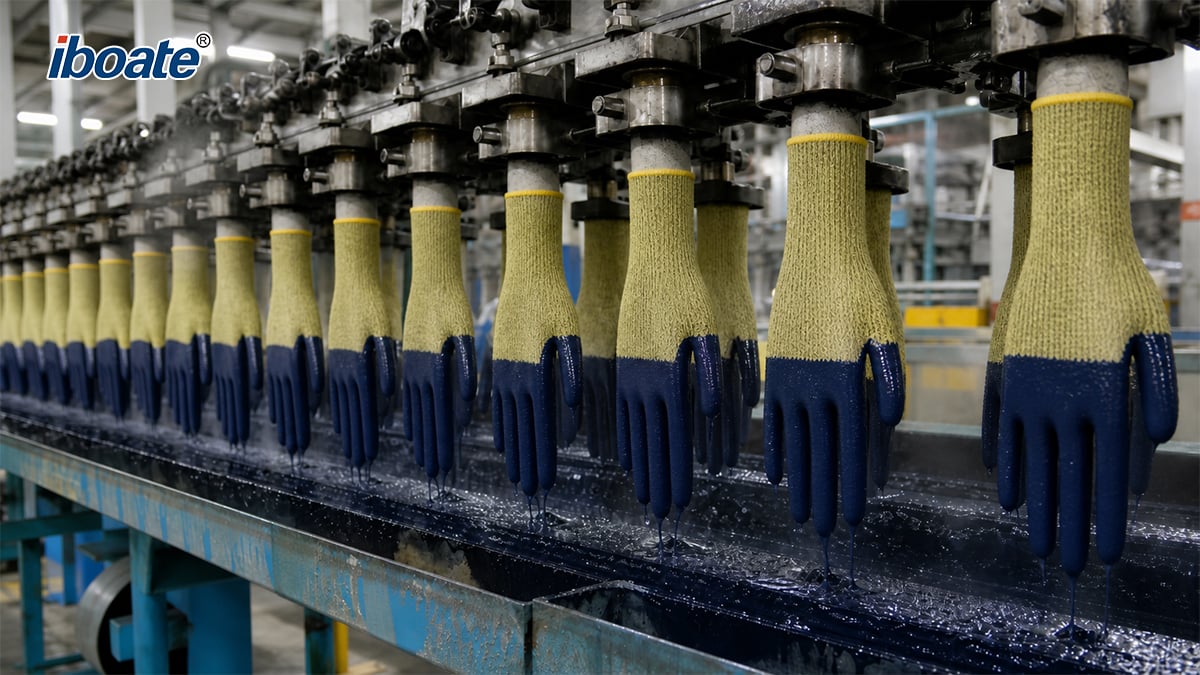
Different performance between batches of identical-spec safety gloves is rarely a single fault. It is the combined effect of variable raw materials, process drift, discrete defects such as pinholes, the statistical limits of sampling, the distance between standard tests and real conditions, ageing, and certification that verifies a type rather than a shipment. Because these causes sit in different parts of the supply chain, no single document resolves them; a layered approach does: evidence per lot, verification on arrival, contractual clarity, and disciplined storage. That is how batch consistency stops being an assumption and becomes something buyers can check.
Does an EN 388 marking guarantee every pair in a shipment?No. EN 388 is a type test on defined samples; the marking reports that sample's level, not a result for every unit.
Are pinholes covered by EN 388?No. EN 388 covers mechanical risks. Liquid and micro-organism penetration sits in the EN ISO 374 series, with pinhole AQL requirements such as EN 455-1 and ASTM D5151 in the medical categories.
What is the most useful document to request?A per-lot test report or certificate of analysis for the delivered batch, read with the model's type-examination documentation.
[About Shandong Iboate Security Technology Co., Ltd.] — Based in Yantai, Shandong Province, China, IBOATE is a professional PPE manufacturer and supplier with more than 20 years in the industry and global export operations since 2021. The company supplies eight major PPE protection categories — including hand protection — to industrial customers in over 60 countries, backed by ISO 9001, CE and UKCA certified core products, full product traceability and compliance documentation. Website: https://www.iboate.com/ · Email: [email protected]
Same specification does not mean same protection. This briefing explains why safety glove batches vary in protective performance — materials, dipping, pinholes, sampling limits and ageing — and how buyers can verify batch consistency using EN 388, EN ISO 21420 and ANSI/ISEA 105-2024.
 Hot News
2026-10-22
2026-10-10
2026-09-28
2026-09-22
2026-09-08
2026-09-04
Trusted factory-direct supplier of certified industrial safety gear. CE/ANSI approved, exported to 60+ countries. Stable supply, flexible OEM/ODM.
701-702 Zhenghai Building, No.66 Zhujiang Road, Yantai Development Zone, Shandong Province
Copyright © 2026 by Shandong Iboate Security Technology Co., Ltd Privacy Policy 蜀ICP备17038468号

 EN